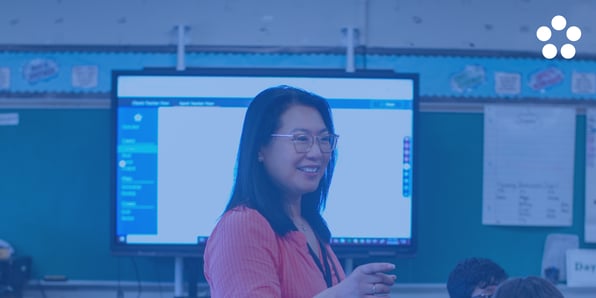
Direct instruction lessons are essential for delivering high-level overviews of key skills and concepts through explicit instruction. Our brief overviews are designed for 15 minutes of Teacher-Led Direct Instruction. However, there are many ways to increase engagement and provide other options for adjusting the model based on student engagement and autonomy needs.
Before we get started on how to implement the Direct Instruction lessons, I want to answer the most frequently asked question.
Can I download it and edit the Direct Instruction Lessons?
We do not currently support download and edit, as our Direct instruction lessons are precision-aligned to standards. Also, students will apply the concept or skill in the module in guided practice and be assessed on it in the unit assessments. So the tasks found in the guided practice portion of the module called Apply Your Learning requires this precision-alignment, though later, students can transfer skills to other applications. Teachers can also provide additional examples and scaffolding.
For students with 504s and IEPs who require accommodations, please reach out to your Success manager for support. We will help you provide those accommodations.
Implementation Models
Some teachers like to front-load the skills at the beginning of the module and ask students to reference the Direct Instruction at the point of application, while other teachers like to introduce them at the point use, such as during the Apply Your Learning tasks. Here are a few ways to implement them!
Teacher-Led Direct Instruction: Teachers present the Direct instruction to students in order to provide a high-level overview of the skills and concepts that are the focus of the module. Teachers project the slide show and walk through it with or without the audio support.
Teacher-Led Direct Instruction with Gradual Release of Responsibility
Similar to the Direct Instruction model, teachers can begin the Direct Instruction portion with a presentation and a think-aloud, allowing students to understand how a teacher is processing the overview via the “I Do It” portion. After the first three or more slides, teachers can switch to an interactive “We Do It Together” practice, where the whole class engages in thinking through the concepts presented. For the next section, students can engage together but independently in small groups in a “We Do It Alone” section. The final section is the “Exit Ticket” or comprehension step to represent the “I Do It Alone” section.
Rotational Models
Some teachers group students based on need and work with them on rotations focused on the Direct Instruction, Build Your Vocabulary (Word Study), and Vocabulary (Focus Words with Engaging Routines). Each rotation of 15 minutes allows students to engage in the acquisition of key skills and vocabulary. This routine allows teachers to increase engagement by providing additional support or autonomy based on student needs. (Link to Slide Show)
Flipped Classroom
Students can access Direct Instruction lessons with phones, tablets, or home computers. Therefore, students can preview the lessons on their own, and teachers can spend the Direct Instruction minutes reviewing the student achievement on the Check step and addressing misconceptions. These can be completed before the module or at any point during the module, including the night before the related task.
Bell-Ringers
If you have multiple Direct Instruction lessons in the module and you want to spread them out as part of a bell-ringer routine, students can come in and complete those as they get started for the day. A combination of journals, vocabulary, grammar, and Direct Instruction tasks at the start of class makes great bell-ringers to ground students with purpose for the day.